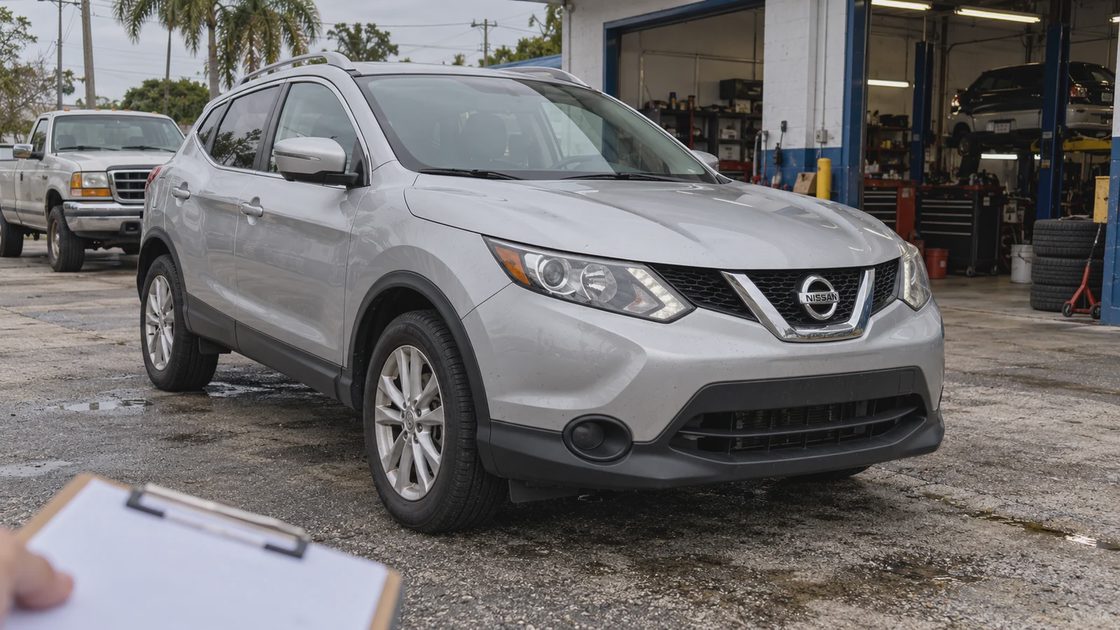
Are Nissans reliable? Some are sensible used buys, but I would judge the exact model, year, powertrain, and service history before trusting the badge. Start by requesting the VIN and maintenance records, then arrange an independent inspection before committing money. A low asking price only helps if the car’s condition and likely expenses fit your budget.
If you are comparing an affordable Nissan with a more expensive alternative, the useful question is whether the savings survive inspection, overdue maintenance, and your need for dependable transportation. That is where I would put the research effort.
What the reliability ratings actually tell you
RepairPal rates Nissan 4.0 out of 5, placing it ninth among 32 brands. However, its methodology says the vehicles included cover the 2010–2019 model years. A page displaying a current year does not turn that historical sample into a forecast for every newer Nissan.
I treat the rating as background. It tells me Nissan deserves consideration; it cannot tell me whether the particular Rogue or Altima in a listing has been neglected.
Three distinctions make reliability information more useful:
Repair frequency: How often does something need attention?
Repair severity: Is the problem manageable, or could it overwhelm the ownership budget?
Downtime: Can you manage an unexpected period without the car?
A buyer with flexible transportation can tolerate uncertainty differently from someone whose car is essential for every shift. The same vehicle can therefore be an acceptable purchase for one household and a poor fit for another.
When comparing year-by-year complaint lists, I also check what the numbers represent. A raw complaint total is not a measured failure rate: you need context about how many vehicles were sold, how long they have been on the road, and what owners reported. Fewer complaints on a newer year do not automatically establish better durability.
Keep crash protection and mechanical dependability separate, too. A favorable crash-test result answers a different question from whether an aging transmission will need repair. Both matter, but one cannot stand in for the other.
Who makes Nissan, and does its background matter?
Brand questions deserve clear answers, but they should take up less attention than the vehicle’s records.
Question | Answer | What it means when shopping |
|---|---|---|
Who makes Nissan? | Nissan Motor Co., Ltd. is the automaker behind Nissan vehicles. | Check the actual vehicle’s configuration and build information. |
Is Nissan Japanese? | Yes. Nissan is a Japanese automaker headquartered in Yokohama. | National origin does not establish an individual car’s condition. |
Where is Nissan from? | Japan; Nissan’s company outline dates its establishment to 1933. | Brand origin and a particular vehicle’s assembly location are different questions. |
Who owns Nissan? | Nissan is publicly traded and owned by shareholders; Renault appears among its principal shareholders. | A shareholder relationship is not a reliability rating. |
Does Nissan own Infiniti? | Yes. INFINITI is Nissan Motor Corporation’s premium brand. | Shared corporate ownership does not make every model mechanically identical. |
These details come from Nissan’s company outline, stock information, and brand overview. Shareholdings can change, so I would check the dated investor disclosure rather than repeat an old ownership percentage.
For a used buyer, corporate history is context. It cannot substitute for knowing which engine and transmission are in the car.
The transmission question comes before the trim package
A continuously variable transmission, or CVT, changes its operating ratio without the fixed gear steps of a conventional automatic. That difference makes transmission identification an essential part of researching a Nissan.
I would not apply one model’s transmission reputation to the entire lineup. Nor would I assume that every year of a familiar model uses the same equipment. Start with the exact year and configuration in Nissan’s manuals and guides.
For example, Nissan’s 2022 Frontier specifications identify a nine-speed automatic, not a CVT. That changes which transmission concerns you research; it does not establish that the truck is trouble-free.
Conversely, a June 2022 Nissan bulletin documented extended CVT coverage for specified Rogue and Pathfinder vehicles, including 2014–2018 Rogue T32 models. The stated limit was 84 months or 84,000 miles, whichever came first. This was a warranty extension, not a safety recall, and an old announcement does not establish coverage today. Check eligibility, time, and mileage against the actual VIN.
For a CVT-equipped candidate, ask:
What transmission service is documented? Look for dates, mileage, and the fluid specification on invoices.
Has the transmission been repaired or replaced? Request the paperwork, mileage at repair, and written coverage terms.
Can an independent shop evaluate it? Give the technician the seller’s statements and any symptoms you notice.
An invoice saying “transmission serviced” leaves important questions unanswered. Have the shop compare the recorded work with the requirements for that vehicle. Fresh fluid alone does not establish that the transmission is healthy.
If the car hesitates, shudders, or makes an unfamiliar noise, I would pause the purchase for diagnosis. Those observations are reasons to investigate, not enough information to name the failed component or price a repair yourself.
Read the history as a timeline
I would arrange the invoices by date and mileage, then compare them with the model-specific maintenance schedule. The aim is to find supported work, unexplained gaps, and upcoming expenses.
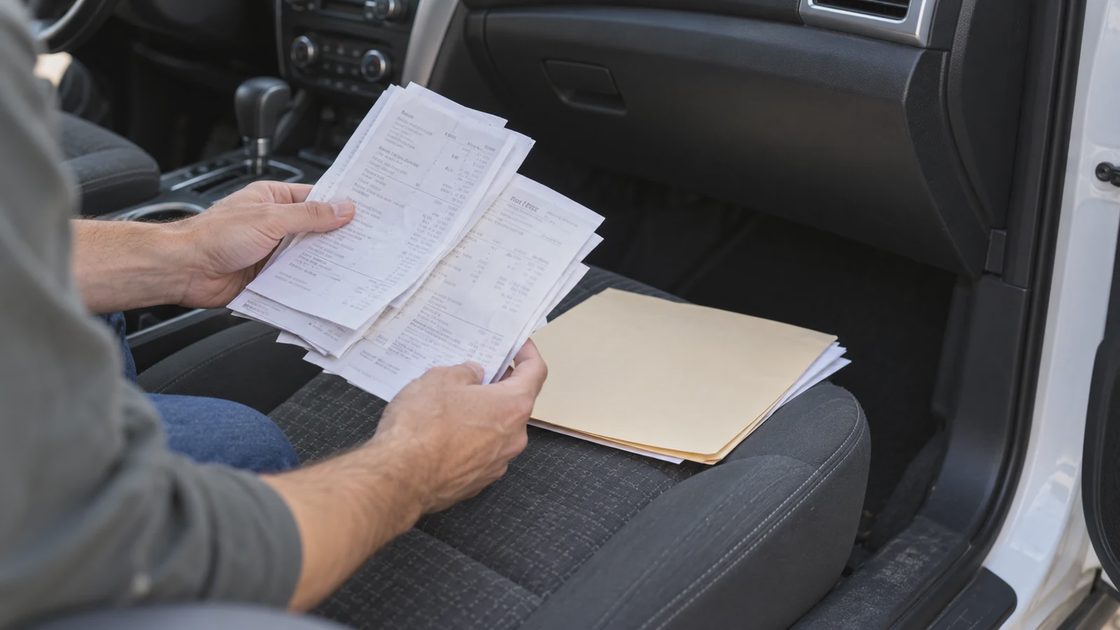
A tidy folder is helpful only when the documents answer practical questions:
Record or observation | What I would establish next |
|---|---|
Oil-change invoices | Do the dates and mileages form a plausible maintenance timeline? |
Transmission paperwork | Does it identify the work, fluid, mileage, and any replacement unit? |
A recently completed major repair | What was diagnosed, what was replaced, and what coverage remains? |
A long gap in records | Can the seller supply missing invoices or explain where service occurred? |
A history report with few entries | Is maintenance simply unreported, or genuinely unsupported? |
Missing paperwork does not prove neglect. It does mean I have less evidence, which changes how much confidence—and money—I would put into the purchase.
Ask about conditions that may leave additional inspection priorities: towing, extended storage, road salt, flood exposure, or commercial use. A seller’s answer guides the inspection; it does not replace it.
Give the inspection a specific job
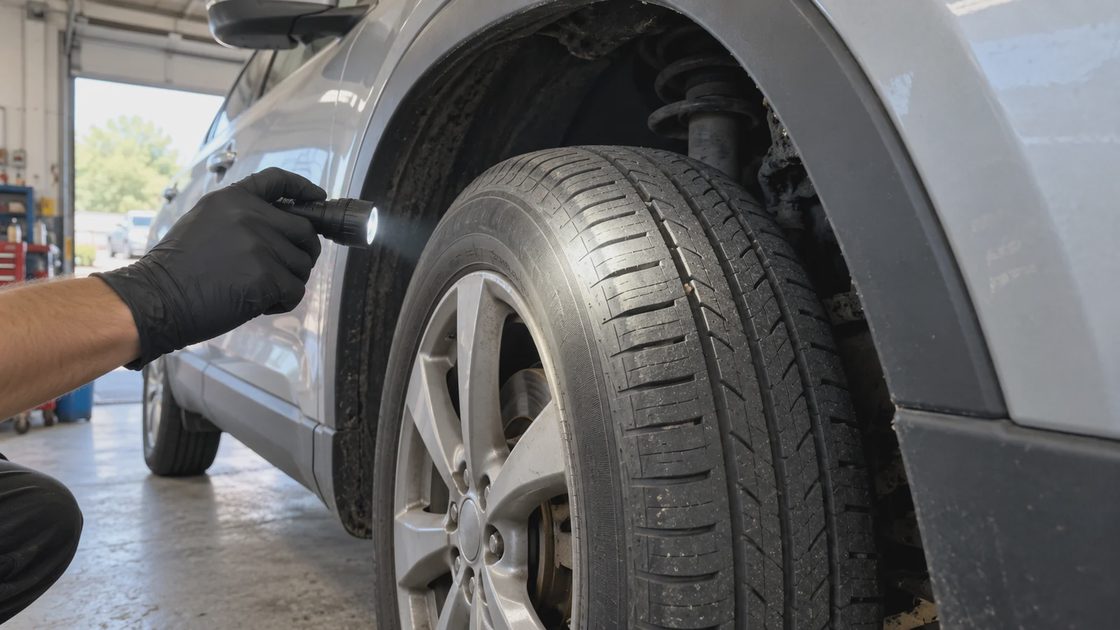
The FTC recommends an independent inspection and explains that a vehicle history report is not a substitute. I would send the shop the listing, available records, and any concerns before the appointment.
Ask for written findings that separate:
Items requiring attention before normal use.
Maintenance due soon, with local estimates.
Problems needing further diagnosis before a purchase decision.
Cosmetic issues you can reasonably accept.
Also run the VIN through NHTSA’s recall lookup. It identifies certain unrepaired safety recalls, but its results have limits: completed recalls and some newly announced campaigns may not appear. “Zero unrepaired recalls” is not a clean bill of mechanical health.
I would ask a Nissan dealer to clarify outstanding campaigns and any claimed warranty coverage for that VIN. Get the relevant terms in writing rather than assuming coverage transfers or includes a particular failure.
Is Nissan a good car when the price is lower?
It can be, provided the discount leaves you with a suitable car and a realistic reserve. I compare purchase price plus identified catch-up work, while keeping unexpected repairs separate.
For me, “is Nissan a good car?” becomes a question about a specific listing: does it meet your passenger and cargo needs, have supportable condition, and leave room in the budget for ownership? A higher trim cannot compensate for a poor answer to those questions.
Suppose you are considering these two cars. The figures below are hypothetical budgeting inputs, not market prices or repair quotes:
Budget item | Nissan candidate A | Alternative B |
|---|---|---|
Purchase price | $10,000 | $11,500 |
Inspection-identified work | $1,200 | $300 |
Subtotal before taxes and fees | $11,200 | $11,800 |
Separate repair reserve | $2,000 | $2,000 |
Cash planned before taxes and fees | $13,200 | $13,800 |
The advertised $1,500 difference becomes $600 after known work. Insurance, fuel, taxes, financing, and downtime could change the comparison further. The equal reserves are assumptions, not predictions that both cars carry equal risk.
If candidate A also has an unresolved transmission concern, I would obtain a diagnosis before treating that $600 as savings. My compromise would be an older interior or fewer convenience features, rather than an unexplained mechanical problem that could disrupt essential transportation.
My decision: proceed, investigate, or pass
For the Nissan you are considering, use three outcomes:
Proceed to negotiation: The configuration suits your needs, records are reasonably supported, and inspection findings fit the budget.
Investigate before offering: Missing service details, uncertain coverage, or an unexplained symptom could materially change the cost.
Pass: The seller refuses an independent inspection, or the purchase leaves no workable way to handle identified repairs and downtime.
Are Nissans reliable enough to consider? Yes—but the strongest purchase argument is evidence about the car in front of you. Before arranging your next viewing, request its VIN and the latest maintenance invoices. Those two items let you begin checking the history before the asking price wins you over.