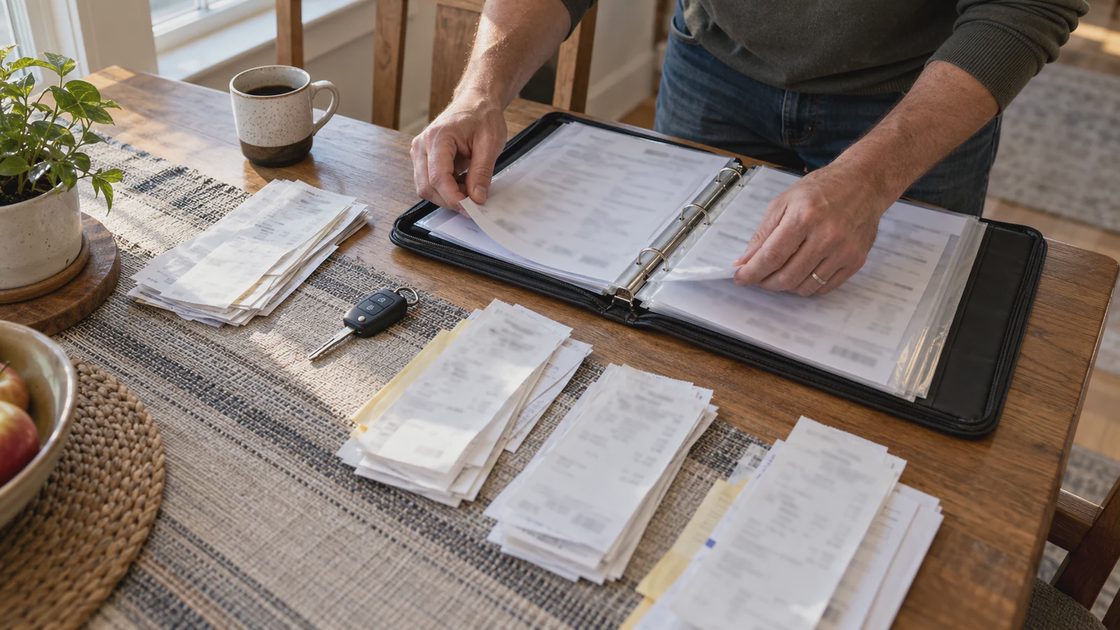
A thick folder of receipts is useful only when it tells a coherent story about the right vehicle. Begin with identity, put the records in date-and-mileage order, and compare the documented work with the applicable Nissan service interval requirements. Then keep completed work, recommendations, and unanswered questions separate.
The aim is not to prove that a used car will never break. It is to decide what the records establish and what an inspection still needs to explain. A Nissan VIN decoder can help identify a vehicle; Nissan oil change coupons can lower a qualifying service bill. Neither can replace evidence that the correct work was actually performed.
1. Establish which car the folder belongs to
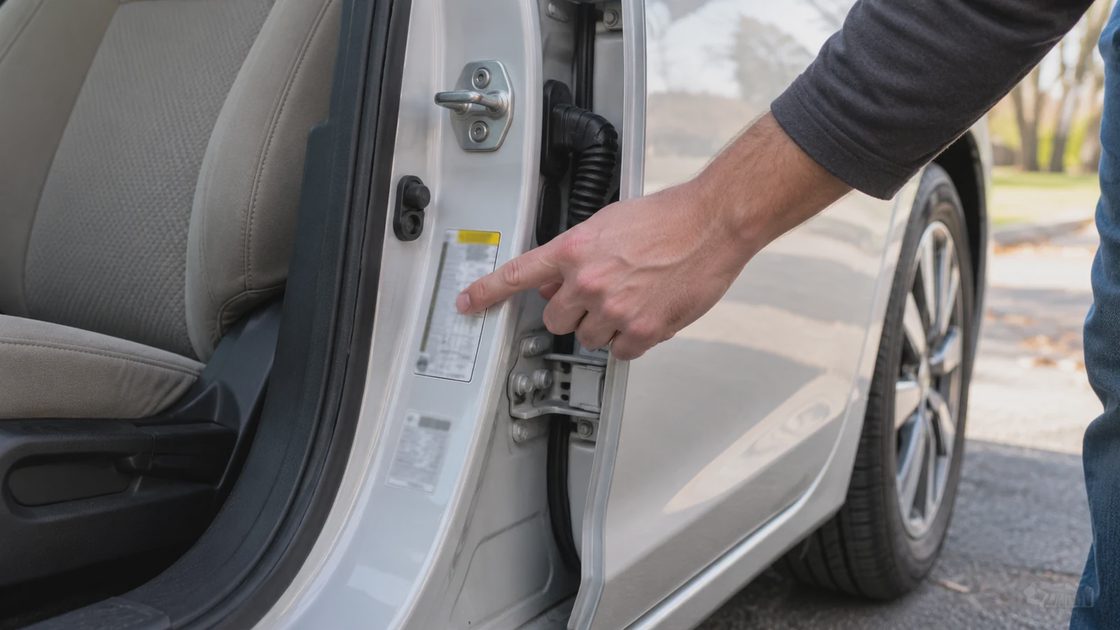
Match the VIN on the car, title or registration, and invoices where recorded. Check identifying details on documents that do not show the full VIN. A receipt for another vehicle owned by the same person does not establish maintenance on this one.
NHTSA’s VIN decoder returns manufacturer-reported information encoded in the VIN. Use it to help confirm identity, then resolve unclear or missing configuration details with Nissan and the vehicle labels.
A decoder is not a complete equipment inventory, title-history report, recall-completion record, or maintenance ledger. When information is missing, do not treat an empty field as proof that a feature or repair never existed. Keep each tool within the question it can answer.
2. Build one timeline before judging any gap
Create a simple row for each invoice: date, mileage, work completed, fluid or part details where relevant, shop, and document reference. Combine records from different shops rather than reading each stack separately.
Field | What to enter |
|---|---|
Vehicle identity | VIN or enough matching identifying information. |
Date and odometer | Both, with a note if either is missing. |
Completed work | The invoiced operation, not a recommendation in the comments. |
Materials | Recorded oil, fluid, part, or tire specification where relevant. |
Supporting document | File name or receipt number you can find again. |
Follow-up question | Anything the invoice does not explain. |
Keep digital copies in the same order. A clear filename can combine the date, mileage, and service topic without exposing the full VIN in a publicly shared folder. Preserve originals when they support a warranty or ownership inquiry.
3. Read what was done, not what was suggested
“Inspected,” “recommended,” “declined,” and “replaced” describe different events. A repair estimate is not a paid invoice, and a paid invoice still needs to identify the work clearly enough to evaluate it.
Hypothetical file audit: a receipt at 24,000 miles documents an oil-and-filter change. At 31,000 miles, another document recommends tires. At 38,000 miles, an invoice records tire installation. The recommendation does not prove installation occurred at 31,000 miles; the later invoice supplies the stronger evidence.

Those mileages are illustrative, not a real owner’s records or an appropriate service schedule. The example shows how separating recommendation from completion prevents a folder from looking more complete than it is.
Ask the shop or seller to explain vague entries such as “major service” or “transmission done.” A detailed record may distinguish maintenance, diagnosis, a component repair, and a complete replacement. Do not assign the strongest meaning to the shortest description.
Investigate a timeline that does not line up
If an invoice shows lower mileage than an earlier record, first check for a transcription error, a different vehicle, or a unit mismatch. Ask for the original document and an explanation rather than immediately accusing someone of fraud or silently correcting the number yourself.
An ownership change can also split the paper trail. A dealer’s available history may omit work performed elsewhere, while a private folder may contain receipts without useful identifying detail. Record the limits of each source instead of treating either collection as complete by default.
When the explanation remains unresolved, keep the discrepancy visible in the inspection and purchase notes. A tidy spreadsheet should not make conflicting evidence disappear. The point of organizing the records is to expose the uncertainty clearly enough to decide whether to investigate further or move to another car.
In the service records I reviewed at the dealership, folders that looked thick on the surface often still had gaps once I lined them up by date and mileage. Those gaps did not automatically mean the work was skipped, but they changed how much reserve I recommended the buyer keep before signing.
4. Match the schedule to the configuration and use
Nissan’s maintenance-schedule tool personalizes information around vehicle configuration, distance, and driving conditions. Its manual portal provides model-and-year documents.
Use those sources for the exact car and applicable operating conditions. Do not copy an oil or CVT interval from another Nissan merely because both cars share a brand or model name. An EV’s maintenance needs also differ from a gasoline car’s.
Where the relevant schedule specifies both elapsed time and mileage, follow its stated rule rather than checking mileage alone. Low annual use does not make calendar time disappear. Conversely, a high-mileage driver can reach a distance requirement quickly.
A missing receipt is a record gap, not conclusive proof that the service was skipped. Ask for other supporting records, then have the inspector explain what can be assessed now and what remains unknown. Do not describe assumed maintenance as documented maintenance.
5. Give transmission entries enough detail
For a CVT or conventional automatic, establish the correct transmission identity before interpreting the fluid description. “Automatic service” does not establish the product or procedure, and one Nissan fluid specification should not be substituted for another without applicable documentation.
If a replacement is claimed, request the installation mileage, unit description, reason for replacement, and warranty terms. A replacement can clarify the history while leaving the need to evaluate present operation. It does not restart every part of the vehicle’s original warranty.
Have a qualified shop investigate unresolved noise, engagement delay, vibration, or poor response. A routine service record cannot diagnose the cause of a complaint that appeared later. Keep the history and the current findings in separate columns until the evidence connects them.
I keep transmission history and current findings in separate columns until the evidence connects them. In the service records I reviewed, folders that listed only “transmission service” or “CVT fluid” without mileage, product, or invoice detail more often required extra diagnosis later when engagement or noise appeared. A documented fluid change can support the timeline; it does not explain a symptom that showed up afterward. I keep that difference visible before I treat the history as complete.
6. Treat tires as a separate record set
For Nissan tires, an invoice should identify the installed product and size. Match that information with the actual tires and the vehicle’s requirements. An invoice for four tires does not prove the same set is still fitted years later.
NHTSA’s tire guidance explains pressure, labeling, maintenance, and aging considerations. Ask the inspector about tread, damage, uneven wear, date markings, and any mismatch. Use the vehicle’s specified cold pressure rather than assuming the sidewall’s maximum is the everyday setting.
A rotation entry documents an operation, not the present alignment or tire condition. Repeated replacements or unusual wear deserve questions, but they do not establish a cause by themselves. Have the current vehicle assessed instead of building an unsupported story from a few invoices.
7. Compare coupons after identifying the required work
A Nissan oil change coupon is useful only if its covered service matches the vehicle and the offer remains valid. Read the oil specification, quantity allowance, filter, labor, fees, vehicle exclusions, participating location, and expiration date.
When comparing Nissan oil change coupons, ask for the final applicable price in writing. A small headline discount can be less useful if the quote excludes required materials or adds compulsory charges. Do not choose an unsuitable oil just to fit an offer.
The same method applies to broader Nissan service coupons. A package containing several operations is not automatically necessary because it is discounted. Compare each operation with the applicable schedule or a documented condition before approving it.
A dealer coupon page examined for this guide illustrated quantity limits, additional taxes and fees, restrictions, and an expiration date. It is an example of terms to inspect, not a recommendation that the displayed offer is valid now or in your location.
8. Keep recalls and warranty evidence outside the routine-service checklist
Use NHTSA’s recall lookup and Nissan to investigate campaigns for the VIN. Ask for the repair order behind a claim that campaign work is complete. A lookup does not supply a full lifetime maintenance history.
For warranty claims, identify the actual program, in-service date, mileage, terms, and authorization requirements. A historical extension, original manufacturer warranty, replacement-part warranty, and purchased service contract answer different questions. Keep the applicable documents together rather than relying on a seller’s general assurance of coverage.
Finish with a one-page inspection brief
Give the inspector three lists: documented work, unresolved gaps, and current symptoms. Ask for written findings separating immediate needs, upcoming maintenance, and matters requiring further diagnosis.
That brief turns a folder into a useful buying tool. Before the next viewing, request the VIN and the most recent invoices, then build the timeline. You will know which questions the paperwork answers and which still need the car, a technician, or a current program check.